Anchor price and 30-day lowest price: how to spot a real discount in Croatian supermarkets
Croatian price tags can show three prices. What the promo price, the 30-day lowest price and the anchor price mean, what changes on 17 November 2026 and how to check a deal with real price data.
By PineziPublished 17 min read
On 25 September 2026, a 150 ml can of Dove Original deodorant was on promotion at Konzum for €3.99. Konzum’s official price list for that day showed three more figures next to it: a regular price of €7.89, a lowest price in the last 30 days of €2.79, and an anchor price of €5.35, which is the price on 2 May 2025.
Those numbers give you three different percentages:
- 49% cheaper than the regular price (€7.89)
- 25% cheaper than the price in May 2025 (€5.35)
- 43% more expensive than the lowest price in the last 30 days (€2.79): from 26 August to 1 September 2026, the same deodorant cost €2.79 at Konzum (lowest price in the chain)
All of these figures are correct. They answer different questions. This article explains what each price on a Croatian price tag means, what changes on 17 November 2026 and how to check a deal in four steps.
Data as of: prices from the retailers’ official price lists for 25 September 2026 and earlier days. Prices change daily, so every example applies only to the dates given. Where a price differs between shops of the same chain, we give the lowest one in the chain. Legal information as of 26 October 2026.
The three prices on a Croatian price tag
When a product is on promotion, Croatian retailers display three prices next to it: the current reduced price, the lowest price of the last 30 days and the anchor price (guidance from the Croatian Ministry of Economy, 22 September 2026, section 1.5, in Croatian (opens in a new tab)). This already applies to food, drinks, cosmetics, cleaning products, toiletries and household products, and from 17 November 2026 it applies to all products. The tags are in Croatian. These are the terms used in the law and in the retailers’ price lists; the exact wording on a tag can vary:
| Croatian term | In English | What it tells you |
|---|---|---|
| Akcijska cijena, Akcija | Promotional price | What you pay now. |
| Najniža cijena u zadnjih 30 dana, Najniža cijena u posljednjih 30 dana | Lowest price in the last 30 days | The lowest price the shop charged for the same product in the 30 days before the promotion started. The discount is measured against this price. |
| Cijena na 2.5.2025., Sidrena cijena, Bazna cijena | Price on 2 May 2025, anchor price | The regular price (without promotions) on a fixed date. It shows how much the price has changed since then. |
| Cijena za jedinicu mjere | Unit price | Price per kilogram, litre or piece. |
When a product is not on promotion, the anchor price appears next to the regular price.
The 30-day lowest price
This rule comes from EU law (Directive (EU) 2019/2161 (opens in a new tab)) and is not new. Amendments to the Croatian Consumer Protection Act (opens in a new tab) in force since 17 June 2026 (NN 59/2026, in Croatian (opens in a new tab)) made it more explicit:
- A promotional sale is a sale at a price below the lowest price the retailer charged in the 30 days before the promotion (Article 20).
- That lowest price is also the reference price for the promotion (Article 19(4)).
- The same applies to advertising, including leaflets (Article 19(6)).
Exception: for promotions on perishable goods and goods close to their use-by date, the 30-day lowest price does not have to be shown (Article 19(5)).
The anchor price
The anchor price (sidrena cijena) is a Croatian government measure under the Act on Exceptional Price Control Measures (NN 40/2025, in Croatian) (opens in a new tab). It is the regular price without promotions on a fixed date. For food and drugstore products, that date is 2 May 2025. From 17 November 2026, the Consumer Protection Act requires it too, under the name bazna cijena, or base price (Article 7).
The ministry recommends that shops show only the date, for example “Cijena na 2.5.2025.” (price on 2 May 2025), without the words “sidrena cijena”. So the tag may show only a date.
The anchor price is a point of comparison with the reference date: it shows how much more or less a product costs today than it did then. Discounts are measured against the 30-day lowest price.
What changes on 17 November 2026
From 17 November 2026, the anchor price applies to all products and services, and every retailer with a website publishes its price lists online. That date comes from two sets of rules:
- Consumer Protection Act. Under the June 2026 amendments (NN 59/2026, in Croatian (opens in a new tab)), from 17 November 2026 a retailer must show the base price next to the retail price and the unit price, meaning the retail price on a fixed date in the past, and publish its current price lists on its website (Article 7). The minister sets the date and the details in an ordinance.
- Government decisions. On 10 September 2026, the Croatian government adopted two decisions (additional price decision (opens in a new tab) and price list decision (opens in a new tab), both NN 101/2026, in Croatian). They were due to take effect on 1 October 2026; on 29 September the government postponed them to 17 November 2026 (opens in a new tab) (NN 110/2026, in Croatian (opens in a new tab)). From then on they replace the May 2025 decision (NN 75/2025) (opens in a new tab).
On 14 October 2026, the Ministry of Economy opened a public consultation on two draft ordinances (pravilnik): one on displaying the base price (opens in a new tab) and one on publishing price lists (opens in a new tab), both in Croatian. The consultation runs until 13 November 2026, and the ordinances are due to take effect on 17 November 2026. According to the ministry (in Croatian) (opens in a new tab), the temporary government decisions will lapse on that date, and the government will adopt separate decisions for this. As of 26 October 2026 the ordinances had not been adopted, so details may still change.
Under the government decisions, the ministry’s guidance and the draft ordinances:
- Anchor price for all products and services. Until now it applied to food, drinks, cosmetics, cleaning products, toiletries and household products. From 17 November, all retailers and service providers must show it, for example for clothing, electronics, furniture, hairdressers or restaurants.
- Two dates. For food, drinks, cosmetics, cleaning products, toiletries and household products, the date stays 2 May 2025. For all other products and services, the price on 10 September 2026 applies. Each product has exactly one anchor price.
- New products. If a retailer offers a product or service for the first time after 10 September 2026, its anchor price is the price on the day it went on sale.
- In advertising too. The anchor price also appears in printed and digital advertising, such as leaflets and websites.
- Prices for particular customer groups are exempt. The rule does not cover benefits that only certain customers get, such as loyalty card prices.
- Online price lists for everyone with a website. Until now, supermarkets, hypermarkets, discounters and cash & carry stores published daily price lists. From 17 November, every retailer and service provider with a website does so, as XML or CSV and separately for each shop. Published lists stay online for 30 days.
- New required fields in the price lists: the anchor price, and whether a price is a promotion, together with the promotion’s name.
- The 30-day lowest price stays optional in the price lists. Supermarket chains have so far included it in their price lists, although the 2025 decision did not require it, and Pinezi shows it next to deals. Neither the new decision (section III) nor the draft ordinance (Article 3) requires this field, so chains may leave it out. On shelf tags and in advertising it remains mandatory under the Consumer Protection Act.
The differences are in the details. Under the decision, retailers update their price lists every day by 8 a.m.; under the draft, they record a change by 11 a.m. on the next working day at the latest. Only the decision asks whether a product is available in the shop. The draft also explicitly exempts personalised prices and dynamically set prices for services.
The 30-day lowest price field matters for anyone comparing prices: if a chain leaves it out of its price lists, checking whether a deal is really lower is only possible with your own price history. Pinezi saves the daily price lists of the chains it covers. For most chains we have price history from at least 26 August 2026, for Kaufland from 3 June and for Eurospin even longer, so we can calculate the lowest price of the previous 30 days ourselves.
The ministry’s guidance of 22 September 2026 (PDF, in Croatian) (opens in a new tab) explains the details of the government decisions (sections 1.1 to 1.5 and 2.1 to 2.5).
How to spot a real deal: four checks
- Is the promo price below the 30-day lowest price? If it is the same or higher, the product was just as cheap or cheaper in the past month. Example: Dove at Konzum, €3.99 on promotion on 25 September 2026, €2.79 from 26 August to 1 September.
- How far is it from the anchor price? A regular price above the anchor price means the product has become more expensive since the reference date. On 25 September 2026, Bellarom instant coffee Gold at Lidl had a regular price of €7.99 and an anchor price of €7.19; the promotion from 25 September (€4.99) was below both. It can also go the other way: on 25 September 2026, 700 g Edamer cheese at Eurospin had a regular price of €6.79, below its anchor price of €6.95.
- How often is it on promotion? If a price drops every few weeks, you rarely need to pay the regular price. If you don’t need something right away, wait for the next reduction.
- What does it cost elsewhere? A percentage shows how much cheaper something is than usual in that chain. To compare with other shops, you need their prices: on 25 September 2026, the same Dove deodorant cost €3.75 at dm without any promotion. Compare prices across chains in our search.
Examples from our data
The charts show the lowest price of a product across a chain’s shops for each day up to 25 September 2026, taken from the official price lists. The examples only illustrate different price patterns.
Dove Original 150 ml: three prices, three percentages
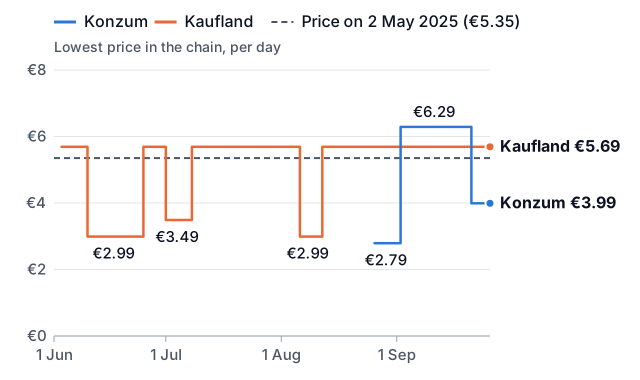
Kaufland: regular price on 25 September €5.69, anchor price €5.35. Between 3 June and 25 September the price dropped temporarily three times: to €2.99 from 10 to 24 June, to €3.49 from 1 to 7 July and to €2.99 from 6 to 11 August. Anyone who bought it at the regular price paid almost twice as much as during a reduction.
Konzum: our data starts on 26 August. The lowest price in the chain was €2.79 until 1 September, then €6.29 until 20 September, and €3.99 on promotion from 21 September. The regular price in the price list on 25 September was €7.89, the anchor price €5.35. On our deals page the product was listed on 25 September with a 49% discount and the note “Lowest in 30 days: €2.79”. You only get the full picture from both numbers together. The price lists do not show in which shops the price was €2.79 or what the shelf tag said at the time.
The same product on 25 September in other chains: dm €3.75, Studenac €3.77 (reduced since 24 September), Konzum €3.99 (promotion), Spar €4.49, Kaufland €5.69.
Grana Padano at Eurospin: a reduction every six to seven weeks
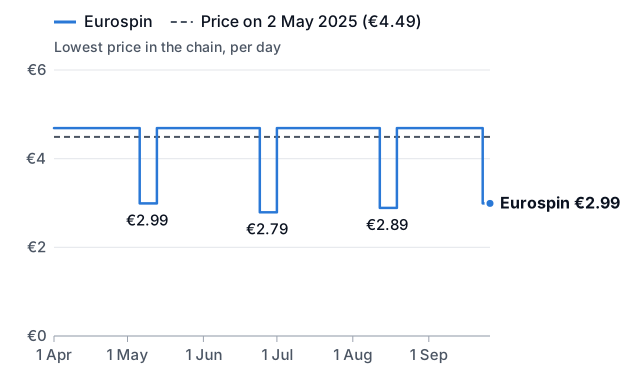
On 25 September 2026, grated Grana Padano (200 g) at Eurospin had a regular price of €4.69 and an anchor price of €4.49. Between 1 April and 25 September the price dropped temporarily four times: to €2.99 from 6 to 12 May, to €2.79 from 24 to 30 June, to €2.89 from 12 to 18 August and to €2.99 from 23 September. Six to seven weeks passed between reductions.
The 30-day lowest price in Eurospin’s price list for 25 September was €4.69, the same as the regular price. There, a 36% discount really was 36% below the price of the previous 30 days.
Rio Mare tuna salad: same price, seven chains, different weeks
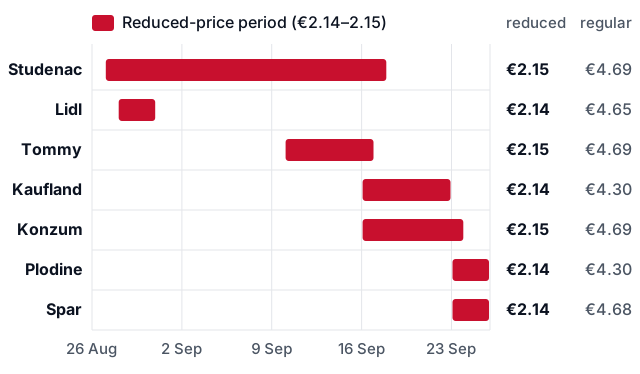
On 25 September 2026, Rio Mare tuna salad Mexico (160 g) had a regular price of €4.30 to €4.69 in the seven chains in the chart, depending on the chain. Between 26 August and 25 September 2026 it was temporarily €2.14 or €2.15 in seven chains, each in a different week: Lidl 28–30 August, Studenac 27 August–17 September, Tommy 10–16 September, Kaufland 16–22 September, Konzum 16–23 September, Plodine and Spar from 23 September. If you buy it regularly, you can buy it wherever it is currently reduced. For Studenac we had price lists for 20 shops during that period.
Barilla Penne Rigate 1 kg: a promotion in one chain, the regular price in another
| Chain | Price on 25 September 2026 | Note |
|---|---|---|
| Lidl | €1.85 | regular price, in all 116 shops |
| Plodine | €1.85 | promotion since 23 September, regular €3.66 |
| Konzum | €3.65 | reduced to €1.85 from 16 to 23 September |
| Spar | €3.65 | |
| Tommy | €3.65 |
At Plodine, this pasta had a 49% discount on 25 September. The promo price there was the same as Lidl’s regular price. What a product costs in other chains only shows in their prices.
Why a percentage can mislead
A discount percentage depends on the price it is calculated from. On our deals page, Pinezi calculates the discount from the regular price and shows the 30-day lowest price next to it. Under Croatian law, the relevant reference is the lowest price in the 30 days before the promotion started.
How far apart the two prices are depends on the chain. For each chain we took the 100 promotions available in the most shops, from the price lists for 25 September 2026. For all chains in the table, these are promotions in all or nearly all shops. We then compared the regular price, the promo price and the 30-day lowest price the chain states in its price list.
| Chain | Promotions where the 30-day lowest price is below the regular price | Promotions where the 30-day lowest price equals the promo price |
|---|---|---|
| Konzum | 86 of 100 | 29 of 100 |
| Plodine | 80 of 100 | 53 of 100 |
| Kaufland | 56 of 100 | 31 of 100 |
| Tommy | 48 of 100 | 1 of 100 |
| Spar | 38 of 100 | 0 of 100 |
| Lidl | 4 of 100 | 1 of 100 |
| Eurospin | 4 of 100 | 0 of 100 |
First column: according to the price list, the product was already cheaper than its regular price somewhere in the chain in the past 30 days: because of an earlier reduction, because regular prices differ between shops, or because the chain includes the current promotion in this field (see the second column). In the first two cases, the percentage based on the regular price is larger than the saving compared with recent prices. At Lidl and Eurospin, the 30-day lowest price equalled the regular price in 96 of 100 promotions, so both percentages meant the same.
Second column: the price list gives the promo price itself as the 30-day lowest price. This can mean that the chain calculates this field over the last 30 days including the days of the promotion, or that the product was already reduced to the same price in the previous 30 days. For the shelf tag, the relevant period is the 30 days before the promotion started. The price lists don’t show what the shelf tag says, so these figures say nothing about whether a retailer follows the rules.
The figures apply to this sample and this date. Studenac is not in the table because on 25 September we had price lists for only 20 of its shops.
Where to report a problem
If a shelf tag shows no anchor price or no 30-day lowest price, or the promo price does not seem to be below it:
- Ask in the shop. The tag may be outdated or in the wrong place. Take a photo of the tag and keep your receipt.
- Send a written complaint to the retailer. Retailers must accept written complaints in the shop, by post and by email, and reply within 15 days (Article 10 of the Consumer Protection Act).
- Contact the State Inspectorate. Price display is supervised by the market inspectors of the State Inspectorate (Državni inspektorat) (opens in a new tab). A complaint about your own case must be filed within 30 days of the retailer’s reply (Article 142). If the problem affects all customers, for example a whole aisle without anchor prices, you can report it as a matter of collective consumer interest (Article 142a); the inspectorate takes it into account when deciding whether to inspect. The online form, the e-Građani service, post and in-person filing are all in Croatian.
For a retailer that is a legal entity, failing to display the anchor price carries a fine of €3,000 to €30,000 (Article 20 of the Act on Exceptional Price Control Measures). For the base price under the Consumer Protection Act, mandatory from 17 November 2026, the fine for a legal entity is €1,500 to €50,000 (Article 149).
Frequently asked questions
Does the anchor price apply to promotions?
The anchor price is always the regular price on the reference date, without promotions or discounts. If a product was on promotion on 10 September 2026, its anchor price is the regular price before that promotion. During a promotion, the anchor price stays on the tag, together with the promo price and the 30-day lowest price.
Why do food tags say 2 May 2025?
The first anchor price decision (NN 75/2025) has applied since 15 May 2025 to food, drinks, cosmetics, cleaning products, toiletries and household products, with 2 May 2025 as the reference date. The new decision (section IV) and the draft ordinance on the base price keep that date for these products. The date 10 September 2026 applies to all other products and services.
Does every small shop have to show it?
Yes. For food, drinks, cosmetics, cleaning products, toiletries and household products, the rule already applies to every retailer. From 17 November 2026 it applies to all retailers and service providers and to all products, whatever their size. The ministry explicitly includes sole traders, the self-employed and family farms (OPG). Only those with a website must also publish price lists online.
Do loyalty card prices have an anchor price?
No. The rule does not apply to prices in retailer apps, loyalty programmes or offers available only to certain groups of customers.
Does fresh produce have to show the 30-day lowest price?
Not necessarily. The Consumer Protection Act exempts promotions on perishable goods and goods close to their use-by date.
Check before you buy
- Our search shows the price of a product in every chain we cover, from the official price lists, cheapest first.
- The deals page lists current promotions in all chains, with the discount and a comparison with recent prices.
- For staple products, see the price caps: the maximum prices set by the Croatian government.
- The Pinezi app for Android and iPhone shows prices by chain on each product page and whether a promo price is below the lowest price of the last 30 days.
Sources
- Amendments to the Consumer Protection Act, NN 59/2026 (in Croatian) (opens in a new tab) and the consolidated text on zakon.hr (opens in a new tab)
- Draft ordinance on displaying the base price, e-Savjetovanja, 14 October to 13 November 2026 (in Croatian) (opens in a new tab)
- Draft ordinance on publishing price lists, e-Savjetovanja, 14 October to 13 November 2026 (in Croatian) (opens in a new tab)
- Ministry of Economy: ordinances on the base price and price lists, 15 October 2026 (in Croatian) (opens in a new tab)
- Decision on displaying an additional price, NN 101/2026 (in Croatian) (opens in a new tab)
- Decision on publishing price lists of products and services, NN 101/2026 (in Croatian) (opens in a new tab)
- Postponement to 17 November 2026, NN 110/2026 (in Croatian): amendment to the additional price decision (opens in a new tab) and amendment to the price list decision (opens in a new tab)
- Ministry of Economy: deadline extended to 17 November 2026 (in Croatian) (opens in a new tab)
- Ministry of Economy: guidance on the decisions (PDF, in Croatian) (opens in a new tab)
- Decision on price lists and an additional price, NN 75/2025 (in Croatian) (opens in a new tab)
- Act on Exceptional Price Control Measures, NN 40/2025 (in Croatian) (opens in a new tab)
- Directive (EU) 2019/2161, EUR-Lex (opens in a new tab)
- Prices: retailers’ official price lists, collected by Pinezi (data sources)
Topics
- price tags
- anchor price
- supermarket deals
- Croatia shopping